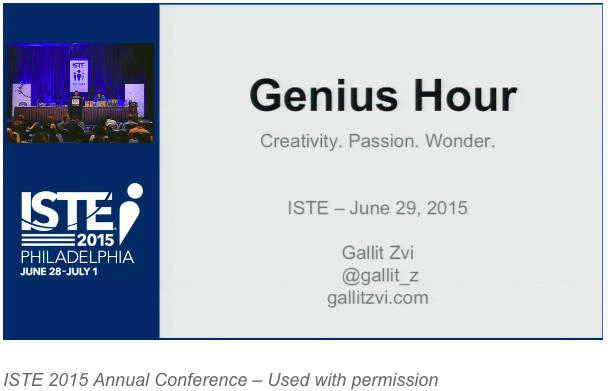
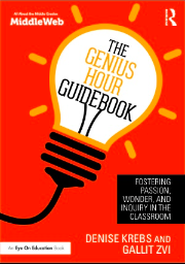
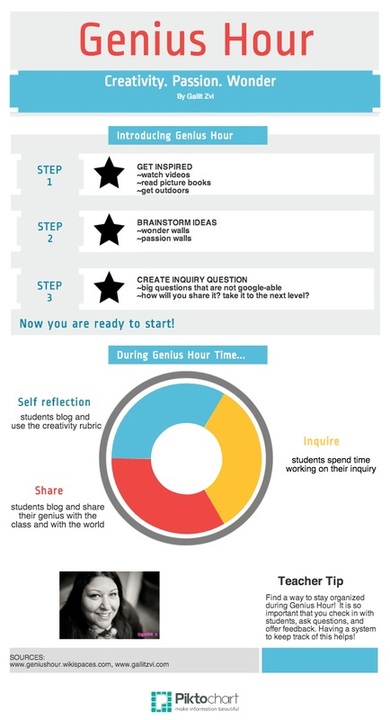
Creativity. Wonder. Passion. "Genius Hour is a precious time, loved by all my students. It is when they are allowed to develop their own inquiry question about whatever it is that they want to explore"
An Index of All My Genius Hour Posts A Few Other Fantastic Genius Hour Links
On the first Wednesday of each month a bunch of fantastic educators get together on twitter for a chat about Genius Hour. The past two chats have been amazing! We had a lot of experienced #geniushour teachers and a lot of newbies too! It was a great mix! We had great conversations, but it was moving so fast that I thought I would summarize some it. We talked about assessment and giving feedback. Most agreed that they did not grade Genius Hour projects, but instead provided formative assessment only. After re-reading over 50 pages of archived tweets, here are some highlights: - 1. Hugh McDonald reminded us of the wonderful creativity rubric that Denise Krebs made a couple of years ago. Hugh and I both use it with our students so that they have something to self-assess with and also as a jumping off point for their blog-refections. We love it!
- 2. Many teachers talked about blogging as a way for students to reflect on their projects, the experience and what went right/wrong. It also provides, as Greg Miller reminded us, the opportunity for peer feedback as well.
- 3. A lot of teachers, Joy Kirr included, also mentioned the importance of informal conversations with students during Genius Hour. She has meaningful, one-on-one chats while students are learning!
- 4. John Stevens talked about using google docs as a method for giving feedback. He also uses google forms for students to submit project ideas. Check that out here.
- 5. Jas Kooner and some others mentioned that they like to give written feedback to their students. She also spoke about the importance of peer-feedback. Many chimed in and agreed. I would love to see any documents/links regarding the way in which people do this. In my class, we comment on each others' blogs as a way of giving peer-to-peer feedback. Any other ideas? Comment below!
- 6. My students also reflect on their Genius Hour projects on their ePortfolios (in the same way that they reflect on every subject). Some students have done great step by step reflections! This way you can track their progress and chat about it with students whenever you have time.
- 7. Lindsey Bingley explained that she gives students "oral feedback, through short conferences during Genius Hour". Sitting down with students for a few minutes to quickly conference is also something that Hugh and I do with our students. This is probably the easiest way for me to touch base with all my students.
- 8. Julie Jee talked about doing monthly journal entries with her high school students.
- 9. Rory Newcomb talked about framing her feedback in a 5-4-3-2-1 format. She blogs about it here.
- 10. Robyn Thiessen told us that her students fill out an action plan each week where they write about what they plan to do and then they self-assess afterwards. She also reminded us of the Global Genius Hour Project and that it can be used for students in other classes to give feedback to each other. Great idea!
There you have it! 10 ways to give feedback. Do you have any others? Comment below! A lot of us shared that we struggled to find the time to connect with every single student. I liked Angela Maiers' advice: "Commit to 5 min a day - make a schedule five learners in five minutes everyday, non-negotiable". This was echoed by Kevin Ashworth when he said that he will often quickly conference with students about Genius Hour, during non-genius hour time! Chris Kesler suggested having students reflect from home, if time is an issue in your classroom! Another interesting point of discussion, brought up by Troy Cockrum, was that of bringing in mentors; parents or community members who could assist students with their projects and provide insight. This is something I am definitely going to look into! This year, Hugh and I had students with skype with some experts for Health and Career class. Why not have them join for Genius Hour too? I love it! We also talked about ways in which students can share their projects. Some common responses: - Ted Talk style speech about what they did/learned
- iMovies and other videos documenting their journey
- Show their model/creation/invention and talk about it
- Powerpoint, Keynote and other slide shows
- Create a website or page on their existing website
- Picture collage/photo journal
Thank you all for participating in the chat and for giving us some things to think about when we implement our next round of Genius Hour.
PLN, did I miss anything? Please comment below! Would love to hear from you!
A few days ago I attended a district dinner for teacher-bloggers and those interested in blogging. Let me start with a thank you to the school district for putting on events like this. I feel so fortunate to work in SD36, a place where innovation and sharing is encouraged! So, over the course of the evening we heard 2 speakers. Jordan Tinney, deputy superintendent, and George Couros, a visiting administrator from Edmonton and dear friend of the SD36 community. It was a pleasure listening to these 2 educators as they shared their stories of engaging in social media and blogging, mentioning both the dangers and benefits of both. George ended the evening with 2 questions: Why did you become an educator? And what legacy do you want to leave? The first one seems pretty straight forward to me...I know why I went into teaching. But the 2nd one was surprising to me...never before had I considered the notion of leaving a legacy. And I still am not sure about this question. So let me start with the first question: I had an amazing Grade 2 teacher, Ms. Mary MacDonald. Honestly, it was so long ago that I am not clear on all the ways in which she was inspiring, but I do know that throughout my elementary years, I always looked up to her. I think she was one of the few teachers that made me feel special and made me feel like she truly cared for me. We made a connection. And so I always had this idea in my head that I wanted to be just like her. Later, in Grade 7, I had another amazing teacher, Ms. Colette Leisen. I didn't get to spend that much time with her as she was our Art teacher (so we probably only had her 2 times each week, I am not exactly sure). Anyway, she, too, made her students feel special. And when I was devastated about my first term report card, it was her that comforted me while I cried. Interestingly, my husband (who went to the same elementary school) also cites Leisen as his favourite teacher whom he remembers as the one who opened up his eyes to the world around him. He didn't just learn about math and art from her, he also learned about life. So, I knew I wanted to be like these 2 women in some capacity. And I knew that I loved working with children (I was a camp counsellor, babysitter and birthday party planner in high school). But I think the biggest motivator to become a teacher hit me when I was in Grade 12. My classmates all started talking about future plans: college, travelling, work, etc. And I had no idea what I was going to do! And I don't think my family did either. Being the child of immigrants, they weren't exactly sure how all that worked over here. And so it was up to me to figure it out for myself. I finished grade 12, got a job and started college shortly afterwards. It was during that time I realized I wanted to be a teacher so that I could help kids like me. I had good parents, but ones that didn't really know how to guide me because they didn't have the same experience here themselves. So I realized that I wanted to become a teacher and help high school students find their passion and figure out what they wanted to do with their lives. And then help guide them in the direction of their dreams.Well, it turns out I ended up teaching elementary school and not secondary, but I think my why is still the same. I help children figure things out about themselves, I share my story and I encourage them to follow their passion. As for what legacy do I want to leave...I don't know if I have an answer to this question. I hope my students remember their experience with me as a time that they felt loved and cared for (as I did with Mary McDonald) and also a time when they learned about themselves and about life (as my husband did with Colette Leisen). And I hope that they are less confused about their future options than when I was a kid. I hope they learn that we are all learners and that it is just a matter of finding your passion. I want Genius Hour to spread so that students have the opportunity to explore their passions at school. And I want to leave them believing in themselves, their abilities, and their futures. What legacy do you want to leave?
 Image by Abode of Chaos – Thierry Ehrmann
5. Personalizing education is so important. Not all learners are the same, so why should their education be the same? Genius Hour allows students to choose their own projects, personalizing their own learning.
4. Kids need time to be creative! Check out Sir Ken Robinson's TedTalk below.
3. Passionate people are successful people. Students need time to find their passions. I am amazed by how many of my students struggle to communicate what their passions really are. They need time to explore their wonders (and often need some guidance with this too) so that they can figure out what they love to do.
2. Inquiry based learning. During Genius Hour students form inquiry questions to investigate. Being able to ask questions is a key competency that we need to develop in students.
1. Teaches resilience. Students will fail during Genius Hour. And they will problem solve and figure out another way to look at the problem. We need to reinforce this learning strategy and Genius Hour is the perfect time for this.
BONUS: ***Genius Hour is FUN. In a survey I did with my class last year, most students listed Genius Hour as one of the top things we did that year!***
Did I miss anything? What would you add to this list?
Haven't tried Genius Hour or 20% time yet? You will love it! Check out the Genius Hour wiki and this post and this post.
I have had a fantastic week! So much professional development! Yesterday I went to a workshop on Challenge Based Learning at Apple Canada Inc. Challenge Based Learning is like Project Based Learning but with an authentic challenge to do something about a real challenge/problem in the world. It was very inspiring! Read more about it here. Then today I was lucky enough to attend the Surrey School district's Engaging the Digital Learner DInner Series and hear Shelley Wright talk about Inquiry Based Learning. Learn more about Shelley here. And finally, Hugh McDonald and I also put together a short video and presentation for the same Dinner Series on Passion Based Learning and Genius Hour. I spent a lot of time this week interviewing students and talking to them about Genius Hour--it was great to hear how passionate they were about Passion Based Learning! Check out our students below: It has been a wonderful week! Lots of learning, reflecting and collaborating! Love it! Special thanks to Antonio Vendramin for supporting me (with release time, etc) to participate in all of these awesome Pro D opportunities, to Elisa Carlson for providing us with such great learning opportunities, to Hugh McDonald for learning/sharing with me, and to my husband for being supportive of my learning and late night Pro Ds. What did you learn about this week?
October 3rd was our last #geniushour chat (click here to learn more about Genius Hour) on twitter. We had a fantastic conversation and some great ideas were shared. Since that chat (click here to see all archived chats), I have had a few more people ask me about how to introduce Genius Hour. So I thought I would compile a list of all the wonderful strategies that were discussed. Here it goes… - Danielle Porte tweeted about doing a guided Genius Hour to start her class off this year. I love this idea! What a fantastic way to be able to model the inquiry process for your class!
- Similarly, Katy Gartside tweeted, “this week they are brainstorming ideas with parents for their indiv proj. Then we'll share, post on wall & they can add ideas” Then they did a group project. I love how she involved the parents into the process!
- Robyn Thiessen’s students have passion portfolios and they store their thoughts and ideas for Genius Hour in them! She introduced inquiry to her young students (yes, it can be done in primary!) through ME projects (delving into topics like what are your values and what are you not...I just love that this is with grades 3s and 4s).
- Denise Krebs' students are researching and presenting their Genius Hour plan before they begin their actual projects. Denise also put together this Genius Hour creativity rubric that students use to show their growth
- Joy Kirr gets her students into the inquiry process by asking them to think not only about what they wonder about, but also to reflect on what really bothers them! What a fabulous way to get students to start thinking.
- Katrina Ling tweeted, “I set up a wonder wall too for #geniushour, we watched videos and brainstormed ideas. There are some kids invention videos from Ellen show.” Watching videos is a great hook! Kids love to see what others have done and it gets them thinking hey I could do that.
- Hugh McDonald also shared how he likes to introduce Genius Hour with YouTube videos that inspire curiosity and talk about Genius. Some videos he uses are:
This year, Hugh and I introduced Genius Hour together. We showed our students the above videos, got them thinking about their passions and wonders and, finally, we modelled it. We both spent some time on a weekend creating our own little Genius Hour projects. Neither of us had ever made a movie using iMovie for iPads and it was something we wanted to learn more about, so we both learned how and created a short iMovie each. Perfect for sharing a little of our lives with our students and for modeling the inquiry process! Thank you Dean Shareski, Antonio Vendramin and Jodi Pulvers for the inspiration. Hugh's Genius Hour 60-1 Second Clip iMovie My Genius Hour 60-1 Second Clip iMovie I am sure there are many more ideas out there from other great teachers about how to introduce Genius Hour. Please comment below if you would like to add to this list!
And I hope this has helped any of you out there that have wanted to start Genius Hour, but didn’t know how. Happy Inquiring :)
One of our painted round tables So, last year we decided to toss out our desks in favour of round tables. Why? Collaboration, community and cooperation! After many talks with my principal, Antonio Vendramin, and my teaching partner, Hugh McDonald, we all decided to give this experiment a try! Sitting at round tables (just like the Kindergarteners) seems to be the perfect way to get students to work on projects together, and to to get rid of the mentality that school work is to be done in isolation, alone, without copying. I don't want to give them the type of work where they can copy the correct answer from their neighbour...I am striving to give them projects where they have to work together with their neighbour, not in isolation from them! We are all enjoying the round tables and our next goal is to paint them all with white board paint. Thus far we have two tables done, one regular round table that students sit at daily and one coffee table that is used in our couch area (one of many alternative work spaces that Hugh and I have in our room). The kids love them and write/draw on them daily. Sometimes just for fun...but lately more and more for educational purposes! Here are some ways we use them... Trying out different ways to use the white board painted tables...word games! Modelling Inquiry: Student Teacher Mr. Reynolds draws what he wonders about. On this day we used the table for students to tell us about how they felt after taking a math quiz. Students were using flyers to add and subtract decimals. Their total bill had to be $100. Students were using the white board table to quickly add numbers to see if they should 'buy' that item or not. Overall, we are pleased with how the tables are being used. During the first few weeks of school the students used them only to draw on, and not really as a learning tool and I was feeling discouraged. But over time, they have started to use them in the way that we had envisioned. Like with any new manipulative or tool, they just need some play time first!
I would love to hear from any teachers that have also painted their desks/tables/furniture with white board paint. How does it work in your classroom? What do the students use them for?
Has anyone else switched to tables recently? How else do you promote collaboration, community and cooperation?
(check with your school district policy before modifying and of their furniture)
I started this blog weeks ago, and then I got busy… I find this happens to me a lot and so my new goal for the next school year is to blog more regularly. I have even put it as a weekly reminder on my phone. Why? Because I think blogging (sharing with others, joining the conversation about education, reflecting on my practice, etc) is a really important part of who I am as a teacher and my professional growth. So I pledge to do more of it over the summer and for the next school year. Side note: If you don’t have a professional blog yet, I highly recommend you start one. It really is a wonderful way to reflect upon your teaching! So, how does this tie into the blog I started earlier? It does…I started writing about how I was lucky enough to have been invited to a professional development day called “Movers and Shakers” a little while back. The guest speaker was George Couros and at one point during the day, he asked us a really great question: “How do we foster innovation in our schools?” He gave us a few minutes to chat at our table groups about this, and so I started asking everyone at my table, “Well, what is the most innovative/best thing you did in your classroom this year?” I asked this because I believe that that is how we can foster and spread innovation of best teaching practice; share! This is nothing new, really. We all know the benefit of and like to take a few minutes to chat in the hallway with our colleagues and share, but what has made my past year so amazing is that I no longer just share with people at my school, because I am on twitter. Now, the world is my hallway! It has made me a much better teacher! I am trying things that I would not have even heard of before, if it weren’t for twitter. Which brings me to my list of the best things I did this year (inspired by George Couros' question & what this blog is really supposed to be about): 1. Genius Hour ( click here to read more about that) Passion Based Learning has changed how I look at education and is LOVED by all of my students. 2. Blogging with my students ( click here to read more about that) and also starting and maintaining my own blog. 3. Joining twitter, building my PLN and meeting amazing educators who inspire me everyday. So, chances are if you are reading this than you are probably already on twitter (I am assuming that is how you found this) but if you aren’t you have to sign up. And then sign up 2 other teachers at your school. Share the learning…because it really is a wonderful place for us all to encourage each other to be more innovative and share best teaching practice. So, that is what I leave you with—a mission—to get two new people on twitter, help them get set up and following some great educators! #sherpapower, right George?
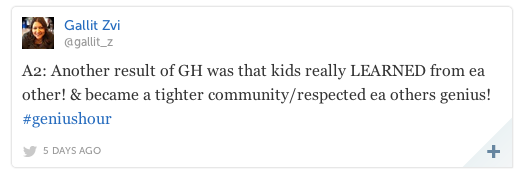
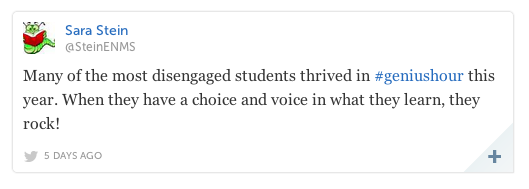
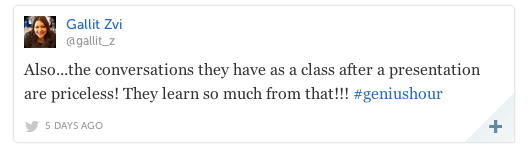
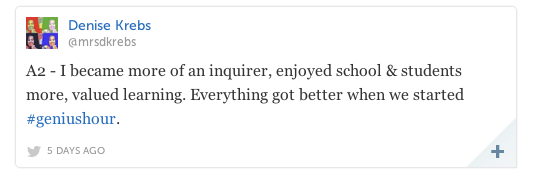
I have a lot of people ask me (well, usually tweet me) this very question. And I realized that I talk about it, blog about it, and tweet about it all the time, but I have not actually put out a definition anywhere. So here it goes... Genius Hour is a precious time, loved by all my students. It is when they are allowed to develop their own inquiry question about whatever it is that they want to explore. They are then given about 3 one hour Genius Hour sessions and then they are usually ready to present their learning to the class. Genius Hour is an amazing time. All the kids are excited and this creates a buzz in the air! Some students are huddled around a laptop doing research on countries they are interested in, others are creating websites, PowerPoints and slideshows on an area of interest, and some are out in the hallway filming movies. Some aren't using technology at all, but rather are building and creating things with their hands. But no matter what they are working on, the common thread is that it is something they are interested in and/or passionate about. I did not invent #geniushour. I wish I had...but I didn't. I want to give credit for the idea of Genius Hour to the right people, but it is hard to tell who actually thought of it first. I heard about it from twitter. A colleague of mine, @HughTheTeacher retweeted @MrsDKrebs tweet with a link to her blog post on the idea of Genius Hour. In it, she gives credit to Dan Pink, author of Drive and to Passion Based Learning expert, @AngelaMaiers. Dan Pink gives credit to a credit union in Washington. And that is as far back as I can track the term "Genius Hour" but of course, the idea that people should be able to learn about what they are passionate about and be given time to become geniuses has been around for a bit. And I won't be able to track the origins of that. So, let's just agree that I did not invent it but I sure do love it! In Pink’s aforementioned blog, he defines Genius Hour in the following way, “Each week, employees [students, in our case] can take a Genius Hour — 60 minutes to work on new ideas or master new skills.” He continues to describe it in one work place, “They’ve used that precious sliver of autonomy well, coming up with a range of innovations including training tools for other branches”( Pink 2011). My students were just as successful. They loved Genius Hour and used their time wisely to learn about topics that they were passionate about (some examples are cooking, countries, Free the Children, iMovie, website design, etc.) Denise Krebs came up with the idea of using a hashtag (#geniushour) and I, later, came up with the idea of a monthly chat and a wikispace (to read more about that click here). So, as you can see this has really been a collaborative project between many of us (we are spread out across North America and yet still able to share our ideas because of twitter). Right when I heard about Genius Hour, I knew it was something that I had to do with my class. I always get excited about giving students authentic tasks that have meaning. So Genius Hour spoke to me. I started talking with the students about this idea and they were immediately excited and eager to start. To those that are nervous about starting something new: Don’t let my excitement mislead you…things did not go perfectly, but that is okay. I have learned so much this year. The students’ genius hour really became my own genius hour too. We learned together, figuring out so much as we went along, and even so I would do much more modeling (of how to chose an inquiry question and share it) in future years, it was not necessarily a bad experience for all of us to have to stop, regroup, take a few steps back and continue. It showed them that I am a learner too. Need another reason to dive in? The BC Ed Plan encourages students to have the opportunity to “discover, embrace and fulfill their passion” (British Columbia Ministry of Education 2011). Passion is so important! In a typical elementary school classroom, students have to learn what we tell them when we tell them. There is little choice in curriculum and so Genius Hour gives them a time to escape these confines and learn about what they want to learn about. And that is when genius happens. In summary, because of Genius Hour I am a changed teacher forever. I no longer need to be in control of all of the learning. I have learned that it is okay, and actually highly beneficial, to step back and allow the learning to happen. I have also learned that inquiry projects are not only valuable to teacher-learners (which is the only way I had thought of them before) but that the students can also benefit from creating interesting inquiry projects themselves. For more information, check out our #geniushour wiki and follow the hashtag on twitter!
|