My visits to 
The Inquiry HUB School in Coquitlam, 
the Inquiry 8 Class @ Fraser Heights Secondary in Surrey,
and more!

Earlier this year I blogged about the power of visiting other classrooms and schools.  Well, since then I have had the opportunity to go on even more classroom visits and I just have to blog about it again!  There are so many amazing educators out there and they are doing amazing things in their classrooms!  Let me tell you about some of them:   
The iHub Inquiry School.  Have you heard of this place?  They are a tiny secondary school in Coquitlam that is doing some big things!  In their words, it is "an innovative, technology driven, full-time program which allows them to pursue their own learning questions by shaping their educational experience around their interests instead of structured classes".  Sounds like a full time Genius Hour program to me...I knew I was going to love it...and I did!  

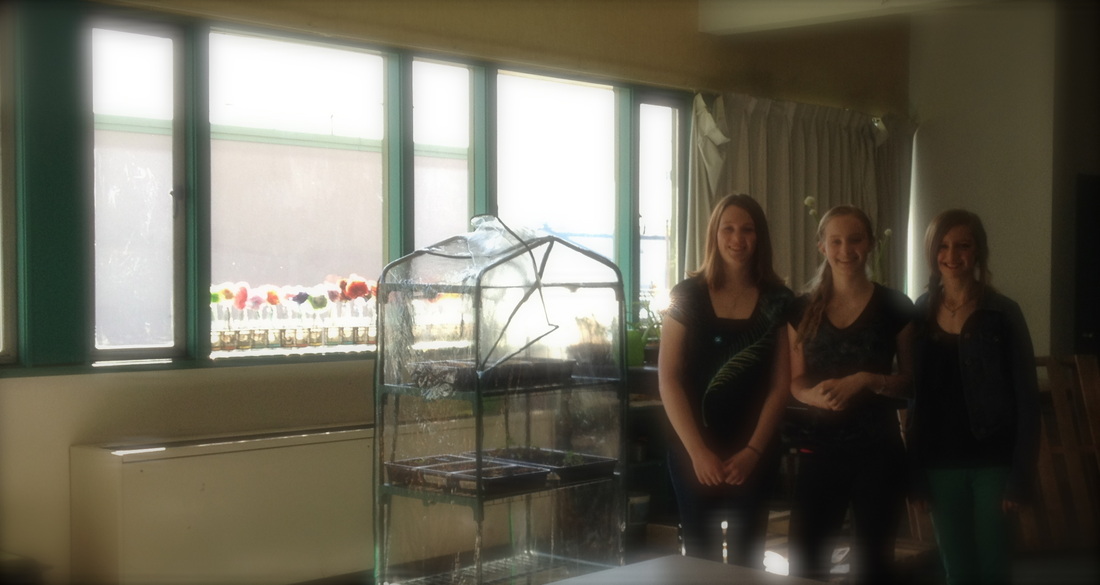
We (I was visiting with Jesse McLean who organized the trip and was kind enough to invite me along) started the morning with a student-led tour of the school.  The 3 girls were great! They clearly explained the school's culture and Jesse and I were very impressed with the vocabulary they used to describe their learning.  The students went on to explain that they were in the middle of an Inquiry project on Urban Gardening.  These amazing 9th graders were planning a school garden, as well as a program that would teach primary students how to garden as well.  It was so inspiring to hear them talk about their learning. 
Picture
Our tour guides pose with some of their seedlings
An important experience, the girls explained, was one that took place early on in the school year.  Their teachers set up an inquiry project for all of them to do, and made sure that their were opportunities throughout for the students to fail.  Yes, FAIL.  I almost cheered!  I have been trying all year to get my students comfortable with the learning process and the obstacles that they will face.  But my students struggle with this notion.  They prefer things to be clear, and for all experiences to be problem-free. We are still working toward being okay with ambiguity and taking risks with our learning.  I was really happy that the girls shared this experience with me.  Something to borrow for sure!  After some time with the students, we sat down to chat with VP, David Truss.  David, thank you so much for taking the time to explain your program to us!  We have so much to learn from what you are doing.

***Major Takeway***
Inquiry needs to be introduced, modeled and scaffolded for the students.  It pays to take the time to do it right!
Picture
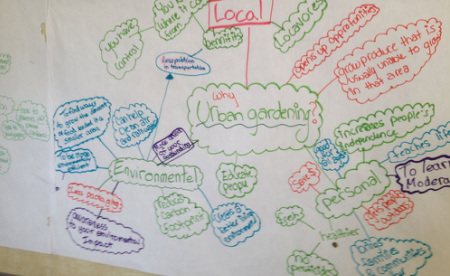
Some of the brainstorming that decorated the walls of the school
After lunch, Jesse and I headed to Fraser Heights Secondary (back in my School District 36).  We wanted to visit Jess Pelat and Parm Brar because they are running a cross-curricular inquiry program with their grade 8s.  Basically, they teach English, Social Studies, Math and Science to the same group of students by doing inquiry projects.  So neat!  I love the idea of keeping those kids together as a cohort for all of their subjects.  And I also appreciated the emphasis on cross-curricular projects, something Hugh McDonald (my teaching partner) and I have been experimenting a lot with this year.  

Jess and Parm, thank you so much for opening up your classroom to us!

***Major Takeway***
Cross-curricular works!  But that doesn't mean you should feel guilty about teaching some stand-alone math lessons, because that is important too.


A few weeks later I had the opportunity to check out a few more schools.  This time they were elementary schools...a little bit more familiar!  First, I spent some time with Trish Miller and Chris Gauvin at Martha Currie. I just loved seeing how they were doing Genius Hour!  It is so great to just watch expert teachers do their thing!  I was so impressed with Trish's students and their projects!  The purpose of my visit to Trish's class was to help her young students get started with blogging, and we did...her adorable grade 3s and 4s took to kidblog immediately!  But while there I was reminded at how important a sense of community is.   Trish cares so much about her students, and it is immediately obvious.  There is such a sense of community and care in her classroom!  It is evident in the way she decorates her room (beautiful baskets of supplies, and student work displayed), in the way she teaches (science through hands on activities such as making a fruit salad while examining the various types of seeds in fruit) and the way she involves her students in the decision making (I watched the students make the decisions about their Genius Hour iMovie).  I am so glad that I got to visit!

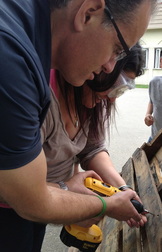
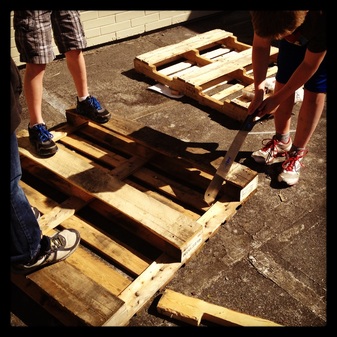
I was also really eager to hear about the gardening project that Chris' students were starting.  His class is trying to figure out how to start an urban garden of their own!  These young 5th and 6th graders were sawing wood, taking measurements and building their own garden out of old pallets.  Reminded me a little of the wikiseat project we are doing at my school.  I just love these hands on activities that make math (measurement, angles, etc) come alive, and are also just perfect examples of authentic learning! 
***Major Takeway***
Community and relationship-building is key.
Other types of building (with a saw, hammer and nails) are also awesome!


Next up was a quick visit to Robyn Thiessen's class at Green Timbers.  Robyn is the Queen of making global connections!  I was so impressed with how her grade 3/4 students conducted themselves during a Mystery Skype call.  Her students were engaged and on task as they tried to guess where in the world the other class was.  

Have you tried Mystery Skype with your class yet? If not, you definitely want to consider it!  Students learn about world geography in the most exciting way!  Check out 6th chat and 4th chat for details! 

Below, is a video that Hugh made of our students during a recent mystery skype call.  
***Major Takeway***
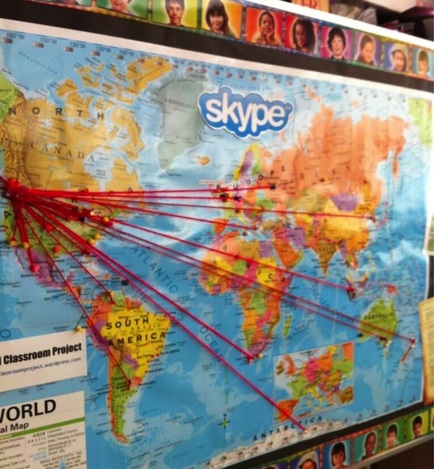
I need to allow my students to make more global connections.  Check out Robyn's mystery skype map below!  Her students are learning so much about the world by skyping with people from all over!
Picture
Picture by Robyn Thiessen https://twitter.com/RobynThiessen/status/332894971126509569/photo/1
I am so grateful for the opportunities I have had to visit colleagues from in and out of district.  None of this would be possible without the connections I have made through twitter.  Having a supportive PLN is amazing. Visiting them to learn through observation and conversation is even more amazing! 
 
 
On the first Wednesday of each month a bunch of fantastic educators get together on twitter for a chat about Genius Hour. The past two chats have been amazing!  We had a lot of experienced #geniushour teachers and a lot of newbies too!  It was a great mix! We had great conversations, but it was moving so fast that I thought I would summarize some it.

We talked about assessment and giving feedback.  Most agreed that they did not grade Genius Hour projects, but instead provided formative assessment only.  After re-reading over 50 pages of archived tweets, here are some highlights:

  • 1.  Hugh McDonald reminded us of the wonderful creativity rubric that Denise Krebs made a couple of years ago.  Hugh and I both use it with our students so that they have something to self-assess with and also as a jumping off point for their blog-refections.  We love it! 


  • 2.  Many teachers talked about blogging as a way for students to reflect on their projects, the experience and what went right/wrong.  It also provides, as Greg Miller reminded us, the opportunity for peer feedback as well. 


  • 3.  A lot of teachers, Joy Kirr included, also mentioned the importance of informal conversations with students during Genius Hour.  She has meaningful, one-on-one chats while students are learning!


  • 4.  John Stevens talked about using google docs as a method for giving feedback.  He also uses google forms for students to submit project ideas.  Check that out here.


  • 5.  Jas Kooner and some others mentioned that they like to give written feedback to their students.  She also spoke about the importance of peer-feedback.  Many chimed in and agreed.  I would love to see any documents/links regarding the way in which people do this.  In my class, we comment on each others' blogs as a way of giving peer-to-peer feedback.  Any other ideas?  Comment below!


  • 6.  My students also reflect on their Genius Hour projects on their ePortfolios (in the same way that they reflect on every subject). Some students have done great step by step reflections! This way you can track their progress and chat about it with students whenever you have time.


  • 7.  Lindsey Bingley explained that she gives students "oral feedback, through short conferences during Genius Hour".  Sitting down with students for a few minutes to quickly conference is also something that Hugh and I do with our students.  This is probably the easiest way for me to touch base with all my students.


  • 8.  Julie Jee talked about doing monthly journal entries with her high school students.


  • 9.  Rory Newcomb talked about framing her feedback in a  5-4-3-2-1 format.  She blogs about it here.


  • 10.  Robyn Thiessen told us that her students fill out an action plan each week where they write about what they plan to do and then they self-assess afterwards.  She also reminded us of the Global Genius Hour Project and that it can be used for students in other classes to give feedback to each other. Great idea!


There you have it!  10 ways to give feedback.  Do you have any others?  Comment below!

A lot of us shared that we struggled to find the time to connect with every single student.  I liked Angela Maiers' advice: "Commit to 5 min a day - make a schedule five learners in five minutes everyday, non-negotiable".  This was echoed by Kevin Ashworth when he said that he will often quickly conference with students about Genius Hour, during non-genius hour time!  Chris Kesler suggested having students reflect from home, if time is an issue in your classroom!

Another interesting point of discussion, brought up by Troy Cockrum, was that of bringing in mentors; parents or community members who could assist students with their projects and provide insight. This is something I am definitely going to look into!  This year, Hugh and I had students with skype with some experts for Health and Career class.  Why not have them join for Genius Hour too?  I love it!
We also talked about ways in which students can share their projects.  Some common responses:
  • Ted Talk style speech about what they did/learned
  • iMovies and other videos documenting their journey
  • Show their model/creation/invention and talk about it
  • Powerpoint, Keynote and other slide shows
  • Create a website or page on their existing website
  • Picture collage/photo journal
Thank you all for participating in the chat and for giving us some things to think about when we implement our next round of Genius Hour.  

PLN, did I miss anything?  Please comment below!  Would love to hear from you!
 
 
Last Wednesday I had the opportunity to spend the day with my new twitter friend, Lindsey Own, in her school in Seattle, Washington.  Lindsey and I met on twitter a little while ago and had chatted a bit about Genius Hour.  She told me that she loves visiting other schools and asked if she could come up to mine during her Spring Break.  Of course I said yes, and told her how much I loved visiting other schools as well.  And so I asked if I could visit hers during my Spring Break (thank goodness we have different breaks so we could make this happen). 
Picture
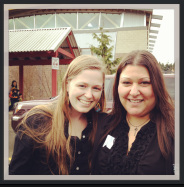
@LindseyOwn and I in front of her school
If you haven't done this before, you need to try it!  It is a wonderful opportunity!  You learn so much just by observing and chatting with a different set of teachers.  I have been lucky enough to have been able to visit other classrooms several times over the years. 

The highlights:
Picture
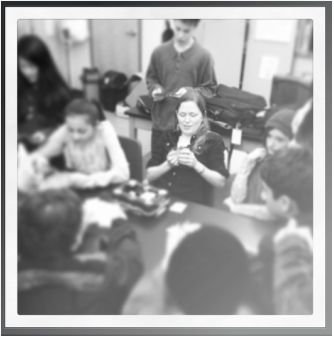
@LindseyOwn playing a game with her students
One of Lindsey's students picked me up from the front office and brought me to her classroom and this is the scene that I walked in on.  Lindsey and a group of her students playing a card game together.  They were chatting and laughing and having a great time.  At first, I was confused...what on earth was going on?  This was science class?  I sat at the side and just watched and realized that it was still before the first period bell.  The children were just warming up for their day.  At Lindsey's school the kids are encouraged to show up 10 minutes before the bell to touch base with their homeroom teacher and get warmed up for their day.  Lindsey uses this time to check in with her students and make a personal connection.  I couldn't stop smiling.  What a wonderful start to their day!

After chatting with Lindsey and touring the school (which included watching the K students get in their daily physical activity by having a little morning dance...so cute), I checked out a math class that is using video games to teach.  Now at first I thought that meant gamification (which I do not know a lot about, but it involves a lot of external rewards, which I try to avoid in my classroom), but I quickly learned that was not what she was doing at all.  Teaching through games is different. The video game she was using, Anti-chamber, is built on problem solving, which related directly to the unit of study in her math class.  Students were engaged, on task and learning.  Very cool.
Picture
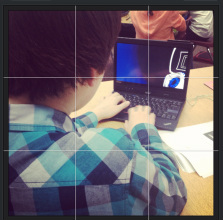
A student playing Anti-chamber
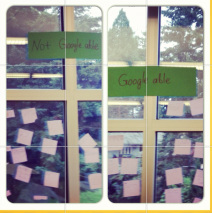
After math, I checked out a few other classes, and then ended my day back in Lindsey's science class where they were working on their Science Symposium (like a Science Fair without ribbons).  I was drawn to the windows in her classroom as they had post-it notes all over them.  I asked her about them, and she explained how they began their science inquiry unit with a discussion about deep questions.  They looked at google-able questions and questions that required more in-depth analysis and which would make a better science project.
Picture
This is something I also spend a great deal of time on with my students.  Not only in Science class, but also in Language Arts, when we ask our students to ask meaningful questions of the texts that we read.  We don't want our students asking surface level questions that they can easily look up the answer to, but rather we want them to dig deeper and come up with questions that require deep thought, critical thinking, and perhaps experimentation to solve.

I loved this post-it note activity and it is definitely something I am going to 'steal' from my visit.  And that is what is so wonderful about these, as Lindsey puts it, "cross-pollination" visits...we can step into someone else's world, look at their classroom and units and 'steal' brilliant ideas.  

When we are beginner teachers, we are told to "beg, borrow and steal" lesson plans from our colleagues.  But I worry that once we gain experience, too many people stop this practice because their filing cabinets are now full of ideas and they don't have to 'shop around' anymore.  But then we risk losing something so incredible...that conversation with our colleagues, both in and out of our own schools.  

I love visiting...I love wandering the halls of my own school and checking out what everyone is doing and I love visiting other schools.  Thank goodness for spring break, professional development days, and a principal who will cover my class so that I get these opportunities.  Thank goodness for twitter, youtube, blogs, pinterest and all the other online platforms I use to connect with other educators.   

Thank you Lindsey and everyone at your lovely school for inviting me into your precious learning space.  I can't wait for you to visit my school!


Every couple of weeks, we get a new topic with #etmooc a recent one was about the meaning behind the buzz words like digital literacy, media literacy...you know what I mean...

I thought a lot about it...what does it mean to me?  And is it important?  And why?

And I realized that my whole transformation as an educator is because of my digital literacy.  Two years ago I began a quest to improve as an educator.  I wanted to take my teaching to the next level.  I thought that meant integrating technology and so that is what I aimed to do...I was going to be a fabulous teacher because I was going to do all kinds of awesome, techy things with my class!  I signed up for twitter, registered for the ITDA program at SFU and started this blog.  And amazing things happened.  I became more digitally literate, but more importantly, I met all of YOU -- I became a connected educator. 

And so, I think what I have come to realize, is that it is not digital literacy that makes us better and stronger educators (people?) but it is the amazing connections that we can now make because of our digital literacy that is really more important.  

Thoughts?


Okay, I am going to be honest here.  I haven't had a chance yet to join one of the #ETMOOC Blackboard Collaborate classes online.  I have added them all to my calendar with great intentions, but they all seem to be at a time where I already had a previous engagement or was still in the middle of my schoolday.  Life can just be so busy sometimes (and eastern time can be oh so early)

That does not mean; however, that I haven't been able to learn with my fellow #ETMOOCers!  Thank goodness for the twitter chat, hashtags and google+ group because that is how I have been able to stay in the loop, join great conversations, and check out your blogs and vlogs.  I have even, most recently, joined a Middle Educators Neighbourhood wiki (thanks to Sheri Edwards for including me in this).  
What a fantastic way to put it...a neighbourhood!  I just love it!  I have said in a previous blog post that you are all my colleagues in my new virtual hallway via twitter, but there is something to the word: neighbourhood.  

It reminded me of the intro song to Mr. Rogers (one of my childhood favourites).  And just how his neighbourhood had a magical feel to it, so too, does my virtual neighbourhood with all of you!  I feel so grateful to have found you all and to have even made friends in my online neighbourhood.  There is something magical to this indeed.

Thank you all for pushing me to best educator I can be by sharing your blogs, tweets, vlogs, comments and words of wisdom.  

What fantastic neighbours I have!


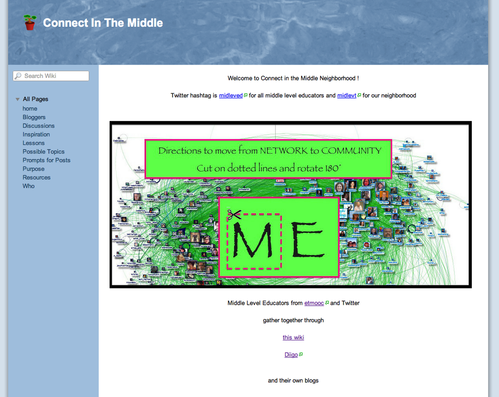
Picture
Connect in the Middle Wiki created by Sheri Edwards. If you are a Middle Grades Educator, click on the picture above and join us!
On the "Connect in the Middle" wiki, Sheri has taken some of the #ETMOOC prompts and encouraged us to blog about:
  • How important is connected learning? Why?
  • Is it possible for our classrooms to support this kind of learning? If so, how?

I think connected learning is so important.  And not just for my students, but for me as well.  As an educator, my practice began to transform when I became connected and started joining "neighbourhoods" of learners and educators.  Hang out in these neighbourhoods long enough and you can't NOT start to reflect on your own practise, start questioning education and make changes/improvements in your classroom. 

And if it works for us, then it should work for our students too?  I believe so.  My students are always excited when they get a comment on their blog from a student in another school.  They loved being a part of the Global Read Aloud, and they keep reminding me that we have to connect with Mr. Hong's class again! Connections are HUGE.  To all of us.

Thank you all for connecting to me and for being in my neighbourhood.


October 3rd was our last #geniushour chat (click here to learn more about Genius Hour) on twitter.
We had a fantastic conversation and some great ideas were shared.   Since that chat (click here to see all archived chats), I have had a few more people ask me about how to introduce Genius Hour.  So I thought I would compile a list of all the wonderful strategies that were discussed. 

Here it goes…

  • Danielle Porte tweeted about doing a guided Genius Hour to start her class off this year.  I love this idea!  What a fantastic way to be able to model the inquiry process for your class!

  • Similarly, Katy Gartside tweeted, “this week they are brainstorming ideas with parents for their indiv proj. Then we'll share, post on wall & they can add ideas” Then they did a group project.  I love how she involved the parents into the process!    

  • Robyn Thiessen’s students have passion portfolios and they store their thoughts and ideas for Genius Hour in them! She introduced inquiry to her young students (yes, it can be done in primary!) through ME projects (delving into topics like what are your values and what are you not...I just love that this is with grades 3s and 4s).

  • Denise Krebs' students are researching and presenting their Genius Hour plan before they begin their actual projects. Denise also put together this Genius Hour creativity rubric that students use to show their growth


  • Joy Kirr gets her students into the inquiry process by asking them to think not only about what they wonder about, but also to reflect on what really bothers them!  What a fabulous way to get students to start thinking.

  • Katrina Ling tweeted, “I set up a wonder wall too for #geniushour, we watched videos and brainstormed ideas. There are some kids invention videos from Ellen show.” Watching videos is a great hook!  Kids love to see what others have done and it gets them thinking hey I could do that. 

  • Hugh McDonald also shared how he likes to introduce Genius Hour with YouTube videos that inspire curiosity and talk about Genius.  Some videos he uses are:

This year, Hugh and I introduced Genius Hour together.  We showed our students the above videos, got them thinking about their passions and wonders and, finally, we modelled it. We both spent some time on a weekend creating our own little Genius Hour projects.  Neither of us had ever made a movie using iMovie for iPads and it was something we wanted to learn more about, so we both learned how and created a short iMovie each.  Perfect for sharing a little of our lives with our students and for modeling the inquiry process! Thank you Dean ShareskiAntonio Vendramin and Jodi Pulvers for the inspiration.

Hugh's Genius Hour 60-1 Second Clip iMovie

My Genius Hour 60-1 Second Clip iMovie

I am sure there are many more ideas out there from other great teachers about how to introduce Genius Hour.  Please comment below if you would like to add to this list!

And I hope this has helped any of you out there that have wanted to start Genius Hour, but didn’t know how.  Happy Inquiring :)


Other educators that have blogged about introducing Genius Hour
Tia Henriksen
Kelley Inden
 
 
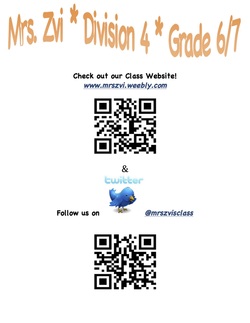
Picture

Last year I started a class website with hopes that parents/guardians would get a better idea of what their children were learning & doing at school. 

It included:

-a schedule of upcoming dates
-links to school district pdfs
-a form with which they could send me messages
-a class blog about upcoming units/projects
-list of daily homework and assignments
-links to educational websites
and more!

I asked parents to complete a survey monkey in which many confessed that they did not really use the website...but all said that they were happy that it existed! 

Well, this year I am hoping to get more of our parents/guardians using our site!  So taking advice from my PLN on twitter this is what I am going to do:

-post this poster outside of my classroom so that parents can easily scan the QR codes to our website and twitter account
-call each parent during the first week of school to personally invite them to Meet the Teacher night so that I can share our website URL and its functions with all of them
-collect parent emails and send messages when important updates are made

Any other advice?  I really want to get more parents/guardians involved this year!
What are you going to do to improve your school/home communication?


Well the summer is over.  It just flew by…because I was having so much fun….learning! 

I grew a lot as a teacher this summer.  From stepping out of my comfort zone to teach 6 year olds in summer school for the first time, to doing a lot of professional reading, to taking another graduate course at SFU.  I spent a lot of time on twitter, learning alongside my fellow connected educators and even “attended” my first webinar.  I presented at a couple of Pro-D events and sat one-on-one with interested teachers sharing my love for blogging and twitter.

I read and I explored and I learned.

It was amazing and it has really made me super excited for this school year!

I know I am going to continue to grow as a teacher this year.  I am travelling with the same group of lovely students into a grade I haven’t taught in a while (6/7), I am team teaching for the first time with a fantastic colleague (@hughtheteacher) and I am committed to offering my students personalized, inquiry/project/passion based learning that is both fun and meaningful to them.  It is going to be an amazing journey…I can feel it!

I am so ready and cannot wait for tomorrow!


I am sitting at Starbucks working with my pal and teaching partner, Hugh McDonald, on our two Professional Development Day presentations that we will be giving this August.  One is called "Introduction to the iPad as an Assessment and Learning Tool".  We thought it would be cool to use a linoit board to gather information from you, our wonderful PLN!  We would love to know what apps you love using with your class and how you use them.  For example, I love "showme" because students can draw, write and speak at the same time about a given topic.  

What do you love using?  Please take a moment to click on the link below and add a "stickie note" to my iPad board!  Thank you so much!  I will also be using this linoit to show my group the power of a PLN on twitter!  You guys rock!

Special thanks to Denise Krebs for first introducing me to linoit.com, I learn so much from you, Denise!
What a great web 2.0 tool!
 
 
The new school year starts on September 4th, and the week after that my new student teacher from SFU, Patrick (aka @runtboy) will begin his Long Practicum with me and my 6/7 class.  But thanks to the magic of Twitter, Patrick and I have been able to connect regularly since we were matched up. 

I had a really great conversation with Patrick the other day and wanted to share it with you all.  We started talking about our summer classes since he has PDP classes this summer and I am working on my Grad Diploma this summer.  Here is an excerpt:
We were discussing two different types of assignments: the first being a traditional essay/paper style assignment and the second being a hands-on project such as building a bird house.  Patrick was talking about how excited he was to build his bird house and this reminded me of our students! Most of them are also much more motivated by hands on projects than the traditional written worksheet/essay! Patrick and I had a great discussion about learning and we definitely see eye-to eye on this, and I am so excited to see what he comes up with for September (and in some cases to be learning right alongside with my students, as Patrick is a very creative person and is sure to be trying things I have never even heard about).

This is such a good time of year for us all to be reminded that we are just like the students that we teach.  Things we find more interesting and more meaningful to our learning are the same types of activities that will resonate with our students.  Now is the time to think about our pedagogy, as we are all (hopefully) reflecting on the past year and thinking about how to improve our practice for the upcoming school year! 

I know that I am going to use some of my time off to read books about motivation (Drive by Dan Pink), teaching non fiction (NonFiction Matters by Stephanie Harvey on advice from @mrsdkrebs) and whatever I can get my hands on regarding project and passion based learning.  I plan on integrating
What will you be adding/changing to the way you teach next year?